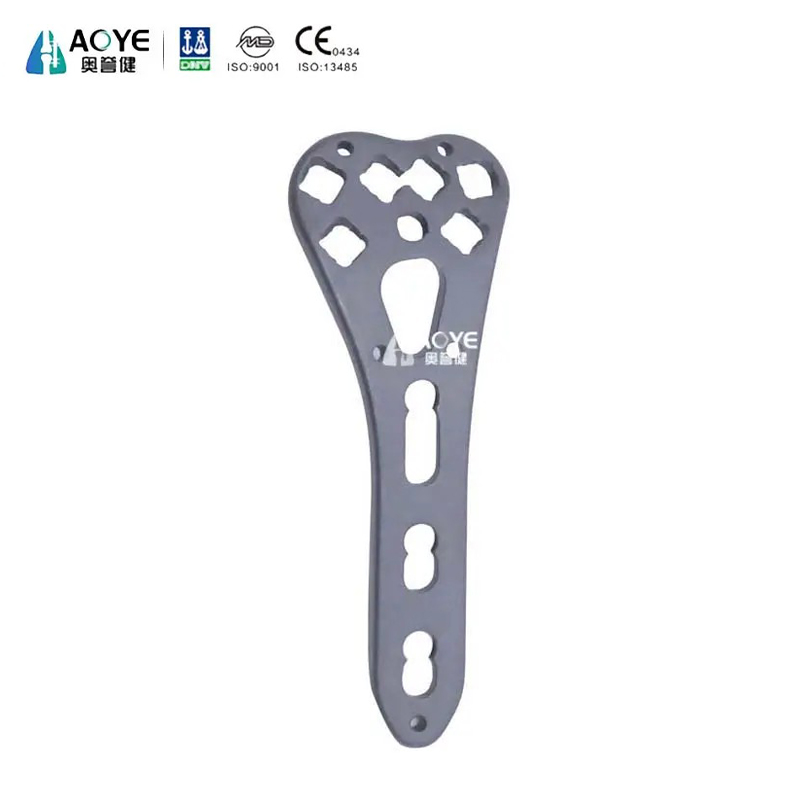
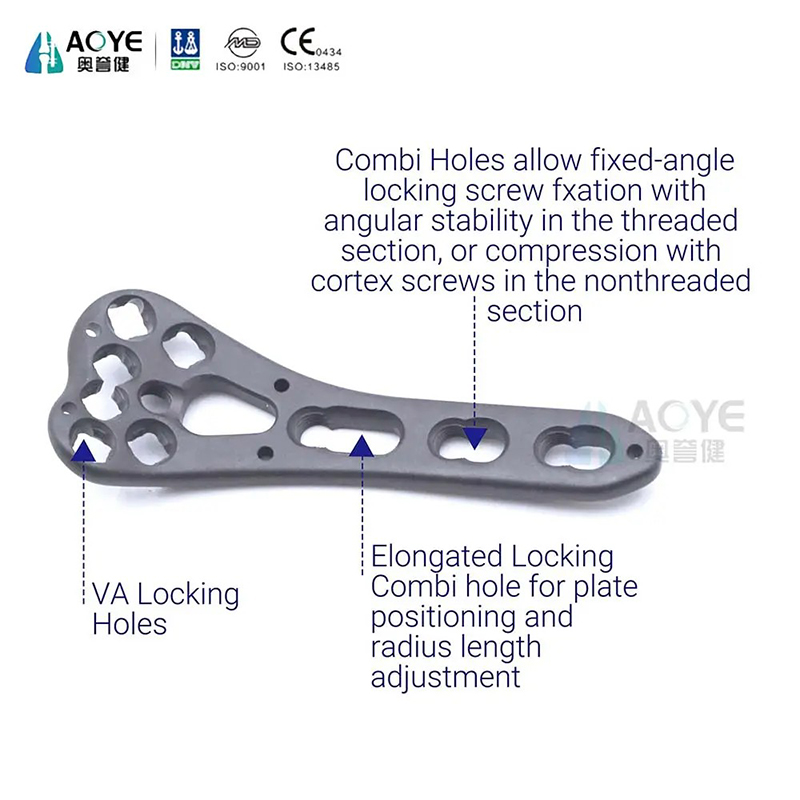
Specification of Volar Distal Radius Variable Angle Two Column Plate
|
Code |
Specification |
Length |
Screw |
|
AY-L127 |
2 Holes L |
2 Holes R |
42mm |
HA2.4
HA2.7
HC2.4
HC2.7 |
|
AY-L128 |
3 Holes L |
3 Holes R |
51mm |
|
AY-L129 |
4 Holes L |
4 Holes R |
63mm |
|
AY-L130 |
5 Holes L |
5 Holes R |
72mm |
Description of Two-Column Distal Radius Plate
The Distal Radius Volar Double-column Locking Plate-I is a titanium alloy internal fixation implant designed for the treatment of complex distal radius fractures using a volar approach. This plate is engineered to support both the radial and intermediate columns of the distal radius, providing balanced fixation across the joint surface.
With its double-column design, the plate allows strategic screw placement to stabilize different fracture segments, particularly in intra-articular and comminuted fractures. Combined with locking screw technology, it offers angular stable fixation, helping maintain reduction and restore wrist alignment during the healing process.
Advantages of Two-Column Volar Distal Radius Plate
Titanium alloy construction: Ensures excellent biocompatibility, corrosion resistance, and durable mechanical strength
Double-column support design: Provides balanced fixation of radial and intermediate columns for improved stability
Volar anatomical contouring: Optimized for the volar surface, enhancing implant fit and reducing soft tissue irritation
Locking screw system: Delivers angular stability, especially beneficial in complex or osteoporotic fractures
Enhanced articular fragment control: Allows precise fixation of multiple fracture fragments
Supports joint surface reconstruction: Helps maintain alignment and reduce risk of collapse
Application of Double Medical Distal Volar Radius Locking Plate
Complex distal radius fractures (intra-articular)
Comminuted distal radius fractures
Fractures involving multiple columns of the distal radius
Osteoporotic distal radius fractures
Wrist reconstruction procedures
Open reduction and internal fixation (ORIF) via volar approach
FAQ
Q1: What does “double-column” mean in this plate design?
A1: It refers to the ability of the plate to support both the radial and intermediate columns of the distal radius, improving stability in complex fractures.
Q2: Is this plate suitable for intra-articular fractures?
A2: Yes. It is specifically designed for complex intra-articular fractures requiring multi-column stabilization.
Q3: What material is used for this implant?
A3: The plate is made from medical-grade titanium alloy, providing strength, durability, and excellent biocompatibility.