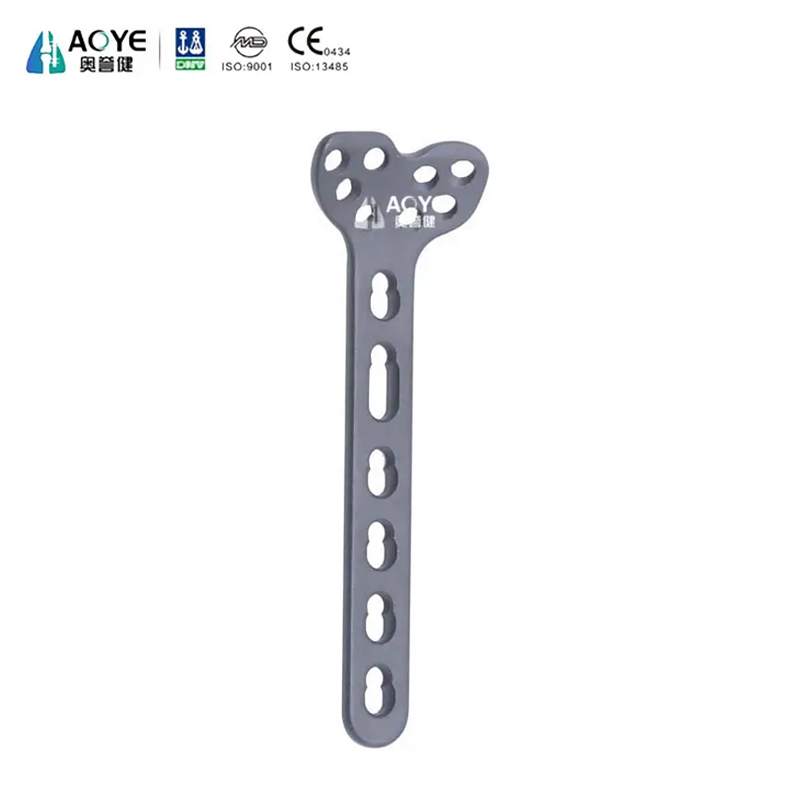
Specification of Distal Radius Locking Plate
|
Code |
Specification |
Length |
Screw |
|
AY-L127 |
3 Holes L |
3 Holes R |
49mm |
HA2.4
HA2.7
HC2.4
HC2.7 |
|
AY-L128 |
4 Holes L |
4 Holes R |
58mm |
|
AY-L129 |
5 Holes L |
5 Holes R |
67mm |
|
AY-L130 |
6 Holes L |
6 Holes R |
76mm |
|
AY-L131 |
7 Holes L |
7 Holes R |
85mm |
Description of Distal Radius Volar Locking Plate
The Distal Radius Volar Anterior Locking Plate is a titanium alloy internal fixation implant designed for the treatment of distal radius fractures through a volar (anterior) surgical approach. It is anatomically pre-contoured to match the volar surface of the distal radius, allowing precise positioning and optimal support of the metaphyseal and subchondral regions.
This locking plate system works with locking screws to provide angular stable fixation, which is essential for maintaining fracture reduction and restoring wrist alignment. It is widely used in both extra-articular and intra-articular distal radius fractures, especially where stable fixation and early mobilization are desired.
Advantages of Distal Radius Volar Anterior Locking Plate
Titanium alloy construction: Excellent biocompatibility, corrosion resistance, and long-term mechanical reliability
Volar anterior anatomical design: Optimized for the volar approach, improving fit and minimizing soft tissue irritation
Locking screw technology: Provides angular stability and enhances fixation strength
Subchondral support: Helps maintain articular surface alignment and prevent collapse
Versatile fixation options: Suitable for a wide range of distal radius fracture patterns
Reduced intraoperative contouring: Pre-shaped design improves surgical efficiency
Application of Distal Radius Plates System
Distal radius fractures (extra-articular and intra-articular)
Volar Barton fractures
Comminuted distal radius fractures
Osteoporotic distal radius fractures
Wrist fracture reconstruction procedures
Open reduction and internal fixation (ORIF) via volar approach
FAQ
Q1: What is the advantage of the volar anterior approach?
A1: The volar approach provides good surgical exposure while reducing the risk of extensor tendon irritation, making it a commonly preferred approach for distal radius fixation.
Q2: Is this plate suitable for osteoporotic bone?
A2: Yes. The locking screw system provides angular stability, which improves fixation in patients with reduced bone quality.
Q3: What material is used in this implant?
A3: The plate is made from medical-grade titanium alloy, ensuring strength, durability, and excellent biocompatibility.