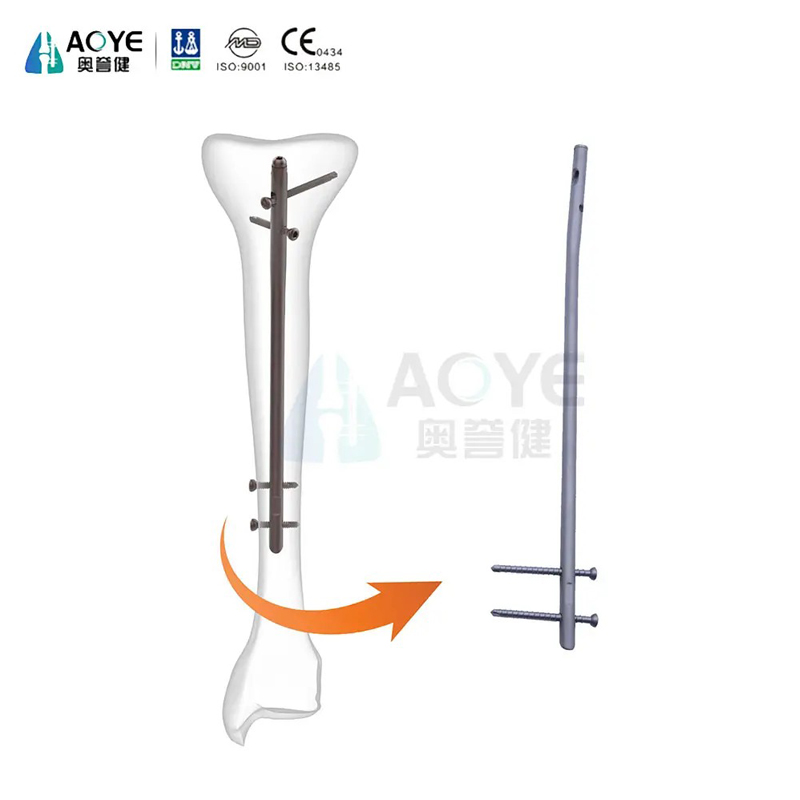
The skeleton is the core of the human motor system, and once a fracture occurs, stable fixation is the key to healing. As a commonly used internal fixation device in the field of orthopedics, intramedullary nail has become an important choice for the treatment of long bone shaft fractures due to its unique fixation principle and clinical advantages. This article will comprehensively analyze the definition, types, application scenarios, application principles and development trends of intramedullary nails, helping you gain in-depth understanding of this critical medical device.
I. Core Definition and Therapeutic Principle of Intramedullary Nails
An intramedullary nail is an orthopedic internal fixation device specifically designed for fracture treatment. Its core function is to be inserted into the medullary cavity of the fracture site, and use the pressure between the bone and the intramedullary nail to keep the fracture ends in stable alignment, thereby creating favorable conditions for bone healing.
Different from traditional external fixation or plate fixation, the fixation method of intramedullary nails is closer to the biomechanical characteristics of bones — it provides support from the inside of the bone, avoiding excessive interference to the peripheral tissues of the fracture site, which is also one of the key reasons for its promoting effect on healing.
II. Common Types of Intramedullary Nails
According to differences in material, function and application site, intramedullary nails can be divided into multiple types, and clinicians will select the appropriate type based on the patient's fracture condition:
1. Classification by Material
- Metal intramedullary nail: Currently the most commonly used type in clinical practice, featuring high strength and good stability, suitable for most adult fracture patients.
- Absorbable intramedullary nail: Made of degradable biomaterials, no secondary surgery is required for removal after surgery, reducing patient pain, and more suitable for children or people sensitive to metal implants.
2. Classification by Function
- Ordinary intramedullary nail: Achieves fixation through the fit between the intramedullary nail and the medullary cavity, suitable for situations where the fracture ends are relatively stable.
- Interlocking intramedullary nail: Further enhances the fixation effect by adding locking nails at both ends of the intramedullary nail, and can be used for comminuted fractures or unstable fractures.
3. Classification by Application Site
- Femoral intramedullary nail: Designed for fractures of the thigh bone (femur), one of the most commonly used types in the treatment of long bone shaft fractures.
- Tibial intramedullary nail: Used for fractures of the lower leg bone (tibia), its design needs to be adjusted considering the anatomical characteristics of the tibia.
- Humeral intramedullary nail: Suitable for fractures of the upper arm bone (humerus), with high requirements for surgical precision.
III. Clinical Application and Core Advantages of Intramedullary Nails
Intramedullary nails are mainly used to treat long bone shaft fractures, such as fractures of the femoral shaft, tibial shaft, and humeral shaft, and are especially suitable for comminuted and unstable fractures. Their clinical advantages are mainly reflected in the following points:
1. More reliable fixation: Intramedullary nails provide support from the inside of the bone, which can align the fracture ends precisely, avoid displacement, and create a stable environment for bone healing.
2. Blood supply protection: Belongs to elastic fixation, which will not excessively compress the blood vessels at the fracture site, preserving the blood supply of bone tissue, which is the key to promoting bone healing.
3. Faster healing speed: A stable fixation environment can accelerate the growth of callus, shorten the healing time, and help patients recover faster.
4. Support for early functional exercise: After surgery, patients can bear weight and perform limb activities early under the guidance of doctors, reducing the risk of muscle atrophy and joint stiffness.
IV. Application Principles of Intramedullary Nails
The use of intramedullary nails for fracture treatment needs to follow strict clinical principles to ensure safety and effectiveness:
- Medullary cavity condition is the premise: It must be confirmed that the patient's medullary cavity has sufficient diameter and continuity, and excessive reaming should be avoided (excessive reaming will weaken the bone quality and increase the risk of thermal necrosis).
- Matching the bone curvature: The stability of non-interlocking intramedullary nails depends on the curvature matching between the nail and the bone — when the curvature does not match, appropriate reaming is required to ensure the fixation effect.
- Special requirements for interlocking intramedullary nails: For fractures within 3~5 cm around the joint, interlocking intramedullary nails or Poller screws should be used to enhance the stability of fixation.
V. Precautions for the Use of Intramedullary Nails
To ensure surgical success and patient safety, the following details should be noted when using intramedullary nails:
- Adequate preoperative planning: Clarify the fracture type and medullary cavity size to ensure that the intramedullary nail can cover the fracture range and provide sufficient stability.
- Evaluate patient tolerance: The patient must have the physical condition to withstand the surgery, such as no severe underlying diseases.
- Prepare appropriate instruments: Confirm that the length and diameter of the intramedullary nail match the patient's bone before surgery to avoid the situation of unsuitable instruments during the operation.
- Attach importance to surgical conditions: Professional instruments, a well-trained medical team, and a hospital environment that meets the requirements are required to reduce surgical risks.
- Avoid excessive stress after surgery: Intramedullary nails are fixation tools rather than bone substitutes, and excessive weight-bearing or activities during the recovery period may lead to bending or breaking of the nail body.
VI. Future Development Trends of Intramedullary Nails
With the advancement of medical technology, intramedullary nails are developing in a more precise and humanized direction:
- Material innovation: Develop materials with better biocompatibility and stronger durability to reduce rejection reactions, and even achieve intelligent degradation (such as optimization of absorbable materials).
- Design optimization: Customized design according to human anatomical structure to make intramedullary nails fit the bone shape better, improving the fixation effect and comfort.
- Technology upgrade: Develop more precise insertion technologies (such as navigation-assisted surgery) to reduce surgical trauma, shorten operation time, and improve success rates.
Summary
As an important device in the field of orthopedic internal fixation,
intramedullary nails provide a stable and safe solution for fracture healing through internal support. Continuous innovation from materials to design enables them to adapt to the needs of different types of fractures and help patients recover limb functions faster. In the future, with further technological development, intramedullary nails will play a more important role in fracture treatment, bringing better treatment experience to patients.