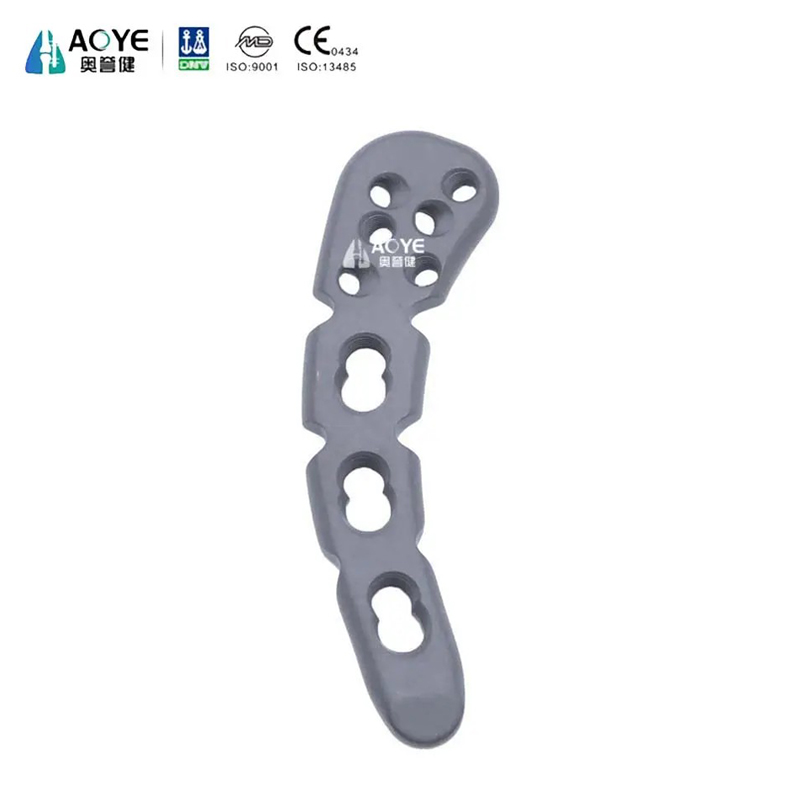
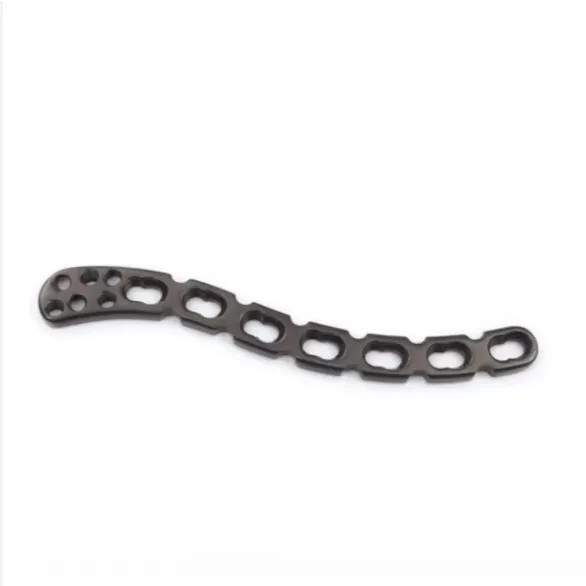
Specification of Anterior Clavicle Plate
|
Code |
Specification |
Length |
Screw |
|
AY-L151 |
3 Holes L |
3 Holes R |
69mm |
HC3.5 |
|
AY-L152 |
4 Holes L |
4 Holes R |
81mm |
|
AY-L153 |
5 Holes L |
5 Holes R |
94mm |
|
AY-L154 |
6 Holes L |
6 Holes R |
69mm |
|
AY-L155 |
7 Holes L |
7 Holes R |
81mm |
|
AY-L156 |
8 Holes L |
8 Holes R |
94mm |
Description of Clavicle System
The Anterior Clavicle Locking Plate is a titanium alloy internal fixation implant designed for the treatment of clavicle fractures via an anterior approach. It is anatomically pre-contoured to match the anterior surface of the clavicle, allowing accurate placement and improved conformity along the bone’s natural curvature.
This locking plate system works with locking screws to provide angular stable fixation, ensuring reliable stabilization in various fracture patterns. The anterior positioning offers an alternative to superior plating, helping optimize implant placement based on fracture type and surgeon preference.
Advantages of Anterior Superior Clavicle Plate
Titanium alloy construction: Excellent biocompatibility, corrosion resistance, and durable mechanical strength
Anterior anatomical design: Pre-contoured to fit the anterior clavicle, improving surgical accuracy and fit
Locking screw technology: Provides angular stability, enhancing fixation in unstable or comminuted fractures
Alternative plating option: Suitable when anterior placement is preferred over superior plating
Reduced hardware prominence: Anterior positioning may reduce soft tissue irritation in selected cases
Stable fixation: Supports maintenance of fracture reduction and functional recovery
Application of Anterior Clavicle Locking Plate
Midshaft clavicle fractures
Clavicle fractures requiring anterior fixation approach
Comminuted clavicle fractures
Osteoporotic clavicle fractures
Trauma surgery and orthopedic fixation procedures
Open reduction and internal fixation (ORIF)
FAQ
Q1: What is the advantage of anterior clavicle plating?
A1: Anterior plating offers an alternative fixation approach that may reduce hardware prominence and provide better positioning depending on fracture characteristics.
Q2: Is this plate suitable for comminuted fractures?
A2: Yes. The locking screw system provides angular stability, making it suitable for complex fracture patterns.
Q3: What material is used in this implant?
A3: The plate is manufactured from medical-grade titanium alloy, ensuring strength, durability, and excellent biocompatibility.