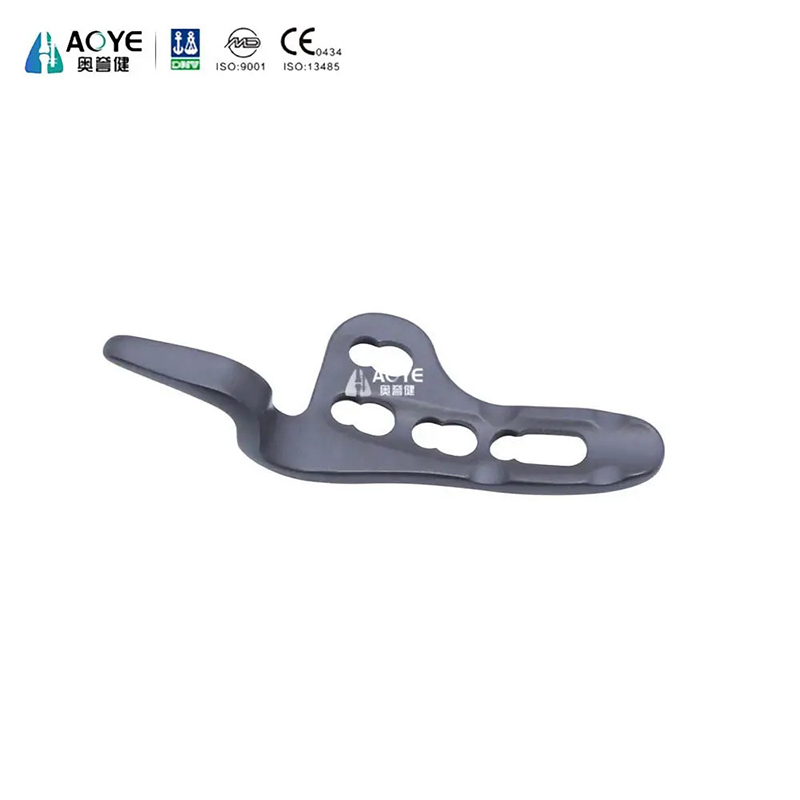
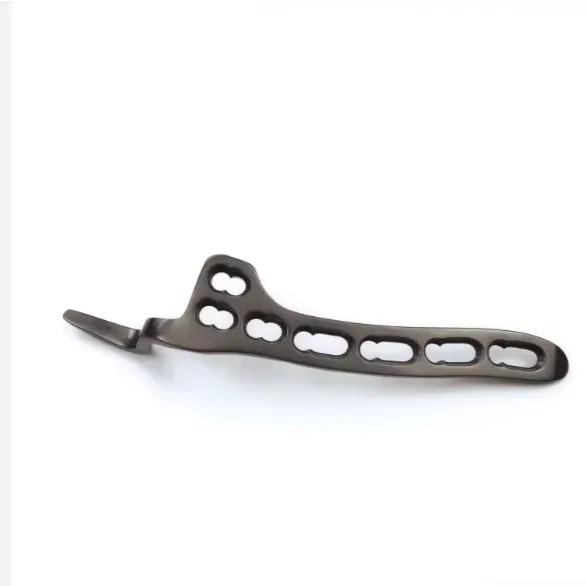
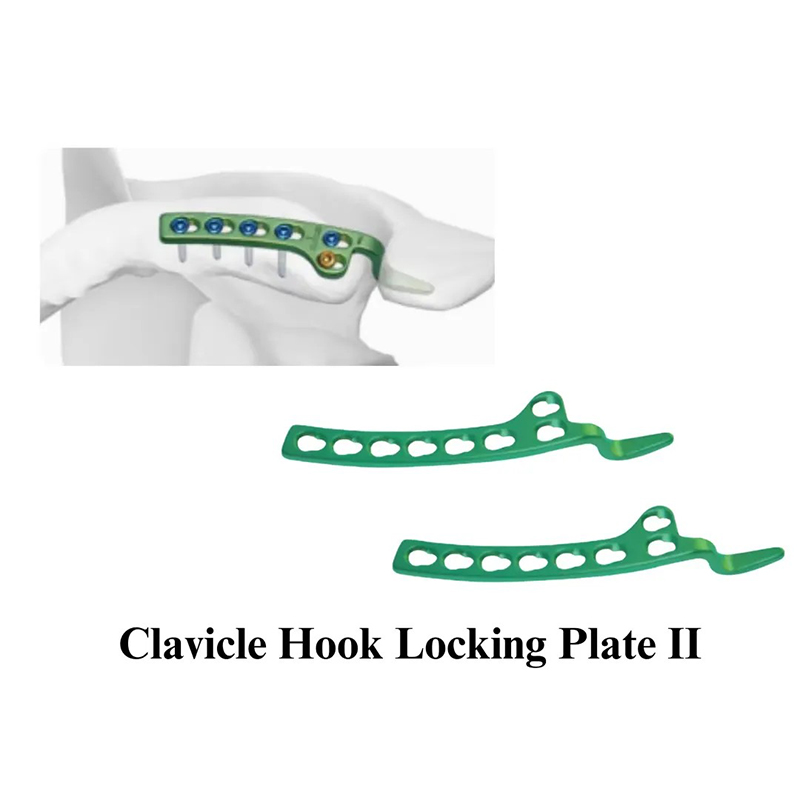
Specification of Locking Clavicle Hook Plate
|
Code |
Specification |
Length |
Screw |
|
AY-L137 |
4 Holes L |
4 Holes R |
70mm |
HA3.5
HC3.5 |
|
AY-L138 |
5 Holes L |
5 Holes R |
85mm |
|
AY-L139 |
6 Holes L |
6 Holes R |
99mm |
|
AY-L140 |
7 Holes L |
7 Holes R |
112mm |
Description of Clavicle Locking Plate System
The Clavicle Hook Locking Plate is a titanium alloy orthopedic implant designed for fixation of distal clavicle fractures and acromioclavicular (AC) joint injuries. It features a specialized hook that is positioned under the acromion, providing leverage and support to maintain reduction of the distal clavicle and stabilize the AC joint.
This locking plate system combines anatomical clavicle contouring with locking screw technology to achieve angular stable fixation. It is commonly used in cases where conventional plates cannot provide sufficient stability, particularly in distal clavicle fractures with ligament disruption.
Advantages of Clavicle Hook Locking Plate
Titanium alloy construction: Excellent biocompatibility, corrosion resistance, and high mechanical strength
Hook design under acromion: Provides reliable support for distal clavicle and maintains AC joint alignment
Locking screw system: Offers angular stability and improves fixation strength in unstable fractures
Anatomical plate contour: Designed to match clavicle shape, reducing intraoperative bending
Effective for ligament-related instability: Supports reduction in cases involving AC joint disruption
Stable fixation in small distal fragments: Suitable for fractures where distal bone stock is limited
Application of Clavicle Locking Hook Plate
Distal clavicle fractures (especially Neer type II fractures)
Acromioclavicular (AC) joint dislocations
Clavicle fractures with ligament injury
Unstable distal clavicle fractures with small fragments
Open reduction and internal fixation (ORIF) procedures
Trauma and orthopedic reconstructive surgery
FAQ
Q1: How does the hook design function in this plate?
A1: The hook is placed under the acromion to provide leverage and maintain reduction of the distal clavicle and AC joint during healing.
Q2: Is this plate suitable for AC joint dislocation?
A2: Yes. It is commonly used to stabilize the AC joint in cases of dislocation or ligament injury.
Q3: What material is used in this implant?
A3: The plate is made from medical-grade titanium alloy, ensuring strength, durability, and excellent biocompatibility.