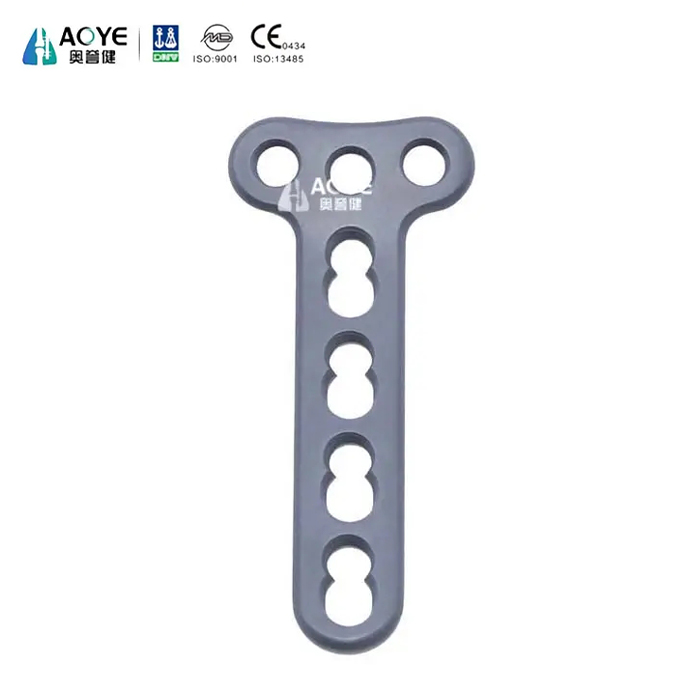
Specification of Locking Distal Dorsal Radius T-Plate
|
Code |
Specification |
Length |
Screw |
|
AY-L112 |
3 Holes |
40mm |
HA2.7
HC2.7 |
|
AY-L113 |
4 Holes |
49mm |
|
AY-L114 |
5 Holes |
58mm |
|
AY-L115 |
6 Holes |
67mm |
|
AY-L116 |
7 Holes |
76mm |
Description of T-Type Locking Plate
The Distal Radius T-type Locking Plate is a titanium alloy internal fixation implant designed for the treatment of distal radius fractures. Its T-shaped configuration is anatomically contoured to fit the distal radius, providing optimal support for both the metaphyseal region and the articular surface.
This locking plate system works with locking screws to create angular stable fixation, which is essential for maintaining fracture reduction and restoring wrist joint alignment. The T-type design allows for multi-directional screw placement, enabling effective stabilization of small articular fragments in complex fracture patterns.
Advantages of Locking Distal Radius System
Titanium alloy construction: Ensures excellent biocompatibility, corrosion resistance, and high strength-to-weight ratio
T-shaped anatomical design: Provides enhanced coverage of the distal radius and supports articular surface reconstruction
Locking screw technology: Offers angular stability, improving fixation in comminuted and osteoporotic fractures
Multi-directional screw placement: Facilitates secure fixation of small fragments and complex fracture configurations
Optimized for wrist anatomy: Supports accurate alignment and restoration of wrist function
Reduced intraoperative contouring: Pre-contoured design improves surgical efficiency
Application of Distal Radius T-Type Locking Plate
Distal radius fractures (extra-articular and intra-articular)
Comminuted distal radius fractures
Intra-articular wrist fractures requiring precise reconstruction
Osteoporotic distal radius fractures
Trauma and orthopedic surgery (ORIF procedures)
FAQ
Q1: What is the benefit of the T-type design in distal radius plates?
A1: The T-shaped design allows better coverage of the distal radius and enables multiple screw placements to stabilize articular fragments effectively.
Q2: Is this plate suitable for intra-articular fractures?
A2: Yes. It is commonly used in intra-articular distal radius fractures where accurate joint surface reconstruction is required.
Q3: What material is used in this implant?
A3: The plate is made from medical-grade titanium alloy, providing strength, durability, and excellent biocompatibility for internal fixation.