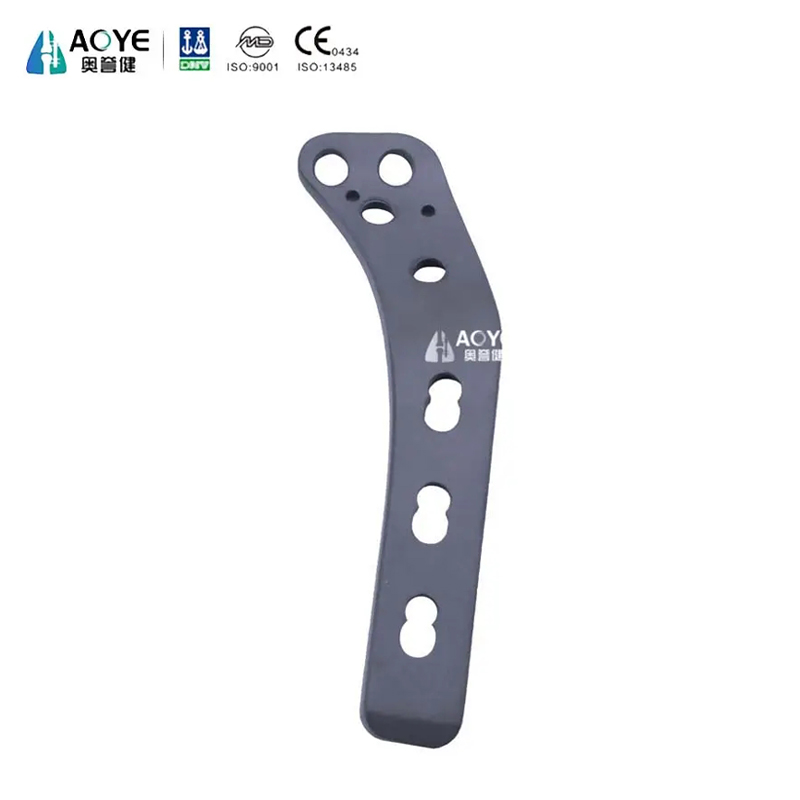
Specification of Tibial Plateau Locking Plate
|
Code |
Specification |
Length |
Screw |
|
AY-L126 |
3 Holes L |
3 Holes R |
103mm |
HA4.5
HC5.0 |
|
AY-L127 |
4 Holes L |
4 Holes R |
121mm |
|
AY-L128 |
5 Holes L |
5 Holes R |
139mm |
|
AY-L129 |
7 Holes L |
7 Holes R |
157mm |
|
AY-L130 |
9 Holes L |
9 Holes R |
175mm |
|
AY-L131 |
11 Holes L |
11 Holes R |
193mm |
|
AY-L132 |
13 Holes L |
13 Holes R |
211mm |
Description of Proximal Lateral Tibia Plate
The Tibial Plateau Locking Plate is a titanium alloy internal fixation implant designed for the treatment of tibial plateau fractures. It is anatomically contoured to match the proximal tibial plateau, allowing precise adaptation to the articular surface and metaphyseal region.
This locking plate system works in combination with locking screws to provide angular stable fixation, which is essential for maintaining joint surface alignment and supporting early functional recovery. It is widely used in complex fracture patterns where stable fixation and preservation of the knee joint structure are critical.
Advantages of Proximal Tibial Locking Plate System
Titanium alloy construction: Offers excellent biocompatibility, corrosion resistance, and reliable mechanical strength
Anatomical design: Pre-contoured to fit the tibial plateau, improving implant positioning and reducing intraoperative adjustment
Locking screw system: Provides angular stability, enhancing fixation in comminuted and osteoporotic fractures
Optimized articular support: Helps maintain joint surface reduction and alignment
Multiple screw options: Allows flexible fixation strategies for different fracture patterns
Supports biological healing: Minimizes disruption to periosteal blood supply when properly applied
Application of Medial Proximal Tibia Plate
Tibial plateau fractures (lateral, medial, and bicondylar)
Split and depression fractures of the proximal tibia
Comminuted proximal tibial fractures
Osteoporotic fracture fixation
Knee joint reconstruction procedures
Open reduction and internal fixation (ORIF) in trauma surgery
FAQ
Q1: What types of fractures can this plate treat?
A1: It is used for various tibial plateau fractures, including lateral, medial, bicondylar, and comminuted fracture patterns.
Q2: Why is locking technology important in tibial plateau fixation?
A2: Locking screws create an angular stable construct, which improves fixation strength and helps maintain joint alignment, especially in complex or osteoporotic fractures.
Q3: What material is used in this implant?
A3: The plate is manufactured from medical-grade titanium alloy, providing strength, durability, and excellent biocompatibility.