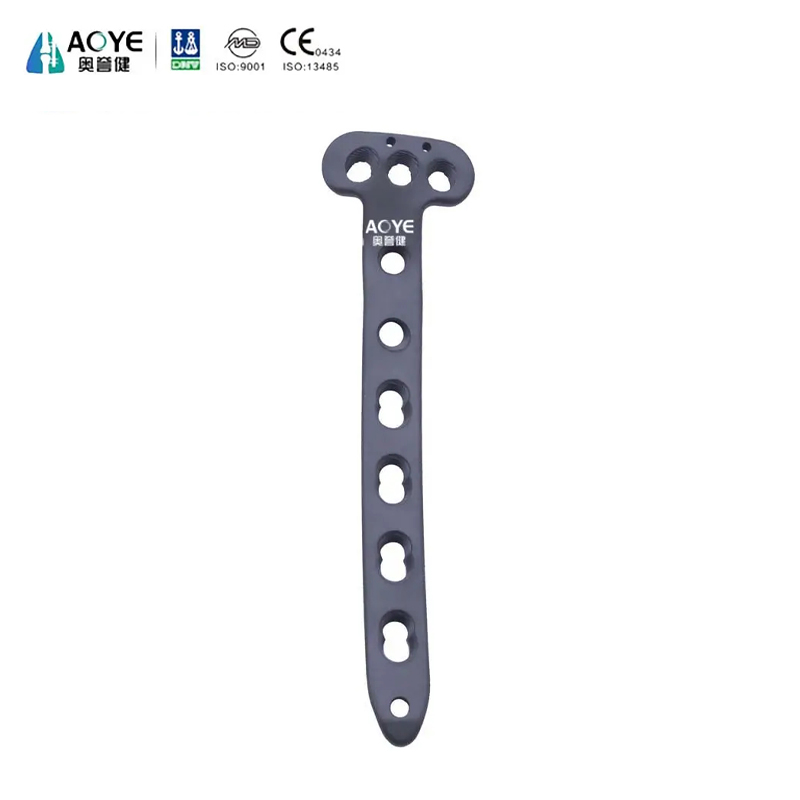
Specification of Proximal Tibial T-Shaped Locking Plate
|
Code |
Specification |
Length |
Screw |
|
AY-L098 |
4 Holes L |
4 Holes R |
106mm |
HA4.5
HC5.0 |
|
AY-L099 |
6 Holes L |
6 Holes R |
142mm |
|
AY-L100 |
8 Holes L |
8 Holes R |
178mm |
|
AY-L101 |
10 Holes L |
10 Holes R |
214mm |
|
AY-L102 |
12 Holes L |
12 Holes R |
250mm |
|
AY-L103 |
14 Holes L |
14 Holes R |
286mm |
|
AY-L104 |
16 Holes L |
16 Holes R |
322mm |
Description of Proximal Medial Tibial T-Locking Plate
The Distal Tibial Medial Locking Plate is a titanium alloy internal fixation implant designed for the treatment of distal tibia fractures along the medial aspect. It is anatomically pre-contoured to match the medial surface of the distal tibia, enabling precise placement and improved conformity without extensive intraoperative bending.
This locking plate system works in combination with locking screws to provide angular stable fixation, which is essential for maintaining reduction in distal tibial fractures, especially in metaphyseal and intra-articular regions. It supports both mechanical stability and biological healing principles in modern orthopedic trauma surgery.
Advantages of Proximal Tibial T-Shaped Locking Plate
Titanium alloy construction: High biocompatibility, corrosion resistance, and reliable long-term mechanical strength
Anatomical medial design: Optimized fit along the medial distal tibia, improving surgical accuracy and implant positioning
Locking screw system: Provides angular stability and reduces the risk of screw loosening
Stable medial column support: Enhances fixation in fractures requiring medial stabilization
Reduced intraoperative contouring: Pre-shaped design minimizes surgical adjustment time
Effective in osteoporotic bone: Locking construct improves fixation in patients with low bone density
Application of Proximal Medial Tibial T-Locking Plate
Distal tibial fractures (extra-articular and intra-articular)
Tibial pilon fractures requiring medial support
Metaphyseal distal tibia fractures
Comminuted distal tibial fractures
Osteoporotic fracture fixation
Open reduction and internal fixation (ORIF) procedures
FAQ
Q1: When is a medial locking plate preferred for distal tibia fractures?
A1: A medial plate is preferred when additional support is required on the medial column, particularly in fractures involving the tibial plafond or when lateral fixation alone is insufficient.
Q2: Is this plate compatible with locking screws?
A2: Yes. It is designed as a locking plate system and provides angular stable fixation when used with locking screws
Q3: What material is used in this implant?
A3: The plate is manufactured from medical-grade titanium alloy, ensuring strength, durability, and excellent biocompatibility.