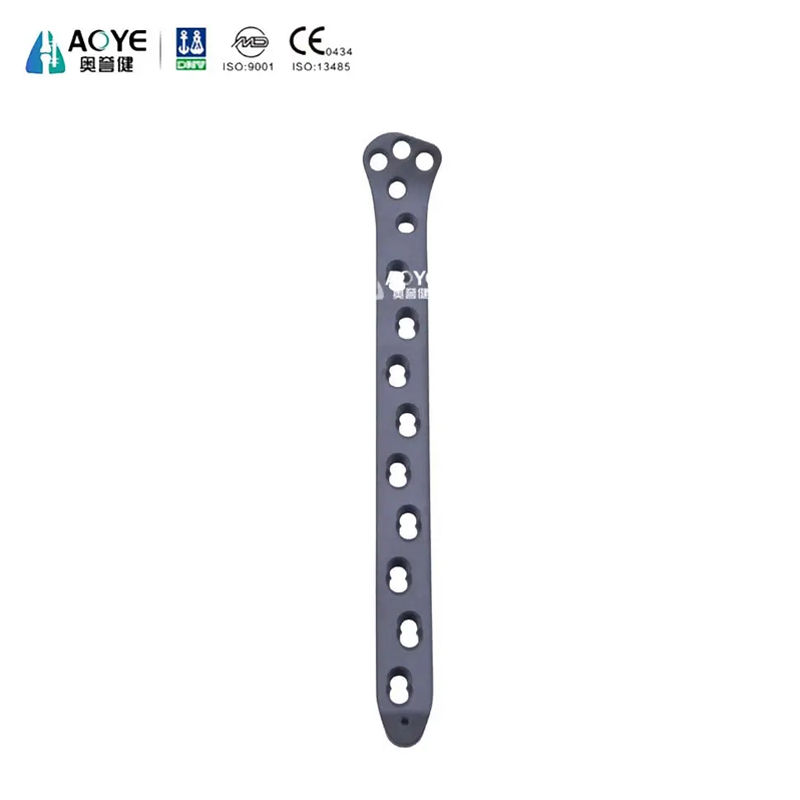
Specification of Distal Femoral Anatomical Locking Plate
|
Code |
Specification |
Length |
Screw |
|
AY-L038 |
5 Holes L |
5 Holes R |
142mm |
HA4.5
HC5.0 |
|
AY-L039 |
6 Holes L |
6 Holes R |
160mm |
|
AY-L040 |
7 Holes L |
7 Holes R |
178mm |
|
AY-L041 |
8 Holes L |
8 Holes R |
196mm |
|
AY-L042 |
9 Holes L |
9 Holes R |
214mm |
|
AY-L043 |
10 Holes L |
10 Holes R |
232mm |
|
AY-L044 |
11 Holes L |
11 Holes R |
250mm |
|
AY-L045 |
12 Holes L |
12 Holes R |
268mm |
|
AY-L046 |
13 Holes L |
13 Holes R |
286mm |
Description of Distal Femur Plate
The Distal Femoral Anatomical Locking Plate is a titanium alloy internal fixation system designed for the treatment of distal femur fractures. It is pre-contoured according to the natural anatomy of the distal femoral region, ensuring accurate adaptation to the lateral femoral condyle and metaphyseal area.
This locking plate system works with locking screws to provide angular stable fixation, making it suitable for complex fracture patterns where conventional fixation may not provide sufficient stability. It is widely used in trauma and reconstructive orthopedic surgery to restore alignment and support functional recovery of the distal femur.
Advantages of Distal Femur Locking Plate
Titanium alloy material: Excellent biocompatibility, corrosion resistance, and long-term implant reliability
Anatomical pre-contoured design: Matches distal femur morphology, improving intraoperative fit and reducing bending time
Angular stable locking system: Enhances fixation strength, especially in unstable and comminuted fractures
Improved fixation in osteoporotic bone: Locking mechanism provides stability even in poor bone quality
Multiple screw options: Allows flexible fixation strategies based on fracture type and surgeon preference
Supports biological fixation principles: Helps maintain fracture alignment while minimizing periosteal disruption
Application of Distal Femoral Anatomical Locking Plate
Distal femur fractures (extra-articular and intra-articular)
Supracondylar femur fractures
Comminuted distal femoral fractures
Osteoporotic distal femur fractures
Peri-prosthetic femoral fractures near the knee joint
Open reduction and internal fixation (ORIF) procedures in trauma surgery
FAQ
Q1: What is the difference between anatomical and standard distal femoral plates?
A1: Anatomical plates are pre-contoured to match the natural shape of the distal femur, reducing the need for intraoperative bending and improving implant fit.
Q2: Is this plate suitable for locking screw fixation?
A2: Yes. It is designed as a locking system and works with locking screws to provide angular stability.
Q3: What material is used in this implant?
A3: The plate is made from medical-grade titanium alloy, offering strength, durability, and high biocompatibility for internal fixation.