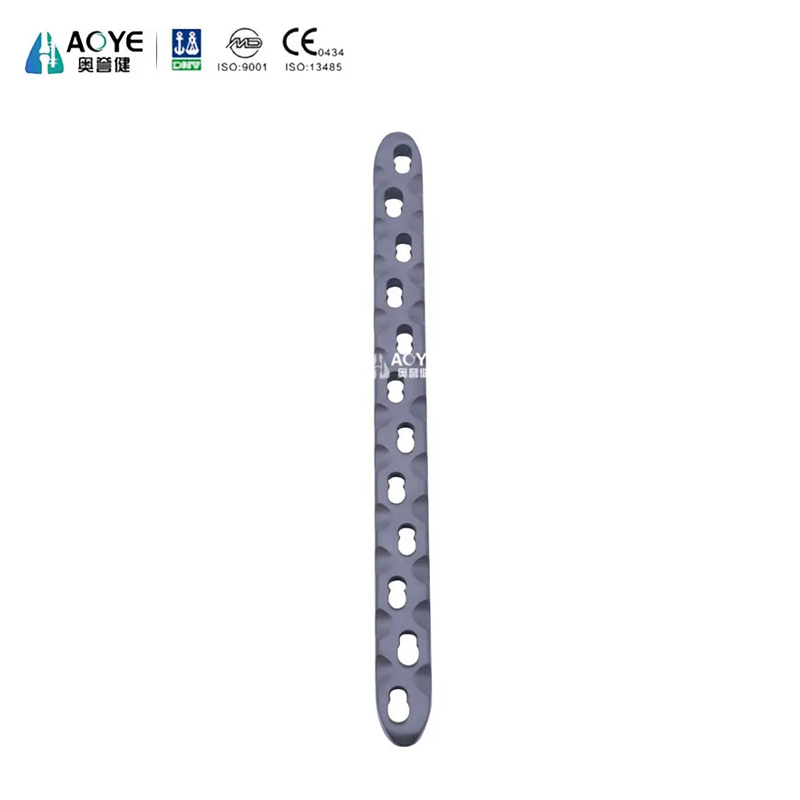
Specification of Femoral Limited Contact Locking Plate
|
Code |
Specification |
Length |
Screw |
|
AY-L012 |
6 Holes |
116mm |
HA4.5
HC5.0 |
|
AY-L013 |
7 Holes |
134mm |
|
AY-L014 |
8 Holes |
152mm |
|
AY-L015 |
9 Holes |
170mm |
|
AY-L016 |
10 Holes |
188mm |
|
AY-L017 |
11 Holes |
206mm |
|
AY-L018 |
12 Holes |
224mm |
|
AY-L019 |
13 Holes |
242mm |
|
AY-L020 |
14 Holes |
260mm |
|
AY-L021 |
15 Holes |
278mm |
|
AY-L022 |
16 Holes |
296mm |
|
AY-L023 |
17 Holes |
314mm |
|
AY-L024 |
18 Holes |
332mm |
Description of Distal Femoral Locking Plate
The Femoral Limited Contact Locking Plate (LC-LCP) is a titanium alloy orthopedic implant designed for internal fixation of femoral fractures while minimizing plate-to-bone contact. The “limited contact” design reduces disruption to periosteal blood supply, supporting biological fracture healing.
This locking plate system combines limited-contact anatomy with locking screw technology, creating a stable angular construct suitable for a wide range of femoral shaft and distal femur fracture patterns. It is commonly used in trauma fixation where both mechanical stability and biological preservation are important.
Advantages of Proximal Femoral Safety Lock Plate
Titanium alloy material: Provides high biocompatibility, corrosion resistance, and strong mechanical performance
Limited contact design: Reduces bone surface compression, helping preserve periosteal blood flow and supporting biological healing
Locking plate system: Offers angular stability, improving fixation strength in unstable fracture patterns
Improved fracture healing environment: Minimizes disruption to surrounding soft tissue and vascular supply
Anatomical fit options: Available in pre-contoured shapes for femoral shaft and distal femur regions
Stable fixation in poor bone quality: Effective in osteoporotic or comminuted fractures when used with locking screws
Application of Femoral Locking Plate System
Femoral shaft fractures
Distal femur fractures
Comminuted femoral fractures requiring bridge plating techniques
Osteoporotic bone fixation cases
Open reduction and internal fixation (ORIF) procedures
Trauma surgery in orthopedic departments and emergency fracture management
FAQ
Q1: What does “limited contact” mean in this plate?
A1: It refers to a design that reduces the contact area between plate and bone, helping preserve periosteal blood supply and supporting biological healing.
Q2: Is this plate suitable for locking screw fixation?
A2: Yes. It is designed specifically as a locking plate system and is used with locking screws to create angular stable fixation.
Q3: What is the benefit of titanium alloy in this implant?
A3: Titanium alloy offers excellent biocompatibility, strength, and corrosion resistance, making it suitable for long-term internal fixation.